Press Release
Hashwallet Expands Internationally With a Self-Custody Cold Wallet That Adds Recovery Without Giving up Control
This content is provided by a sponsor
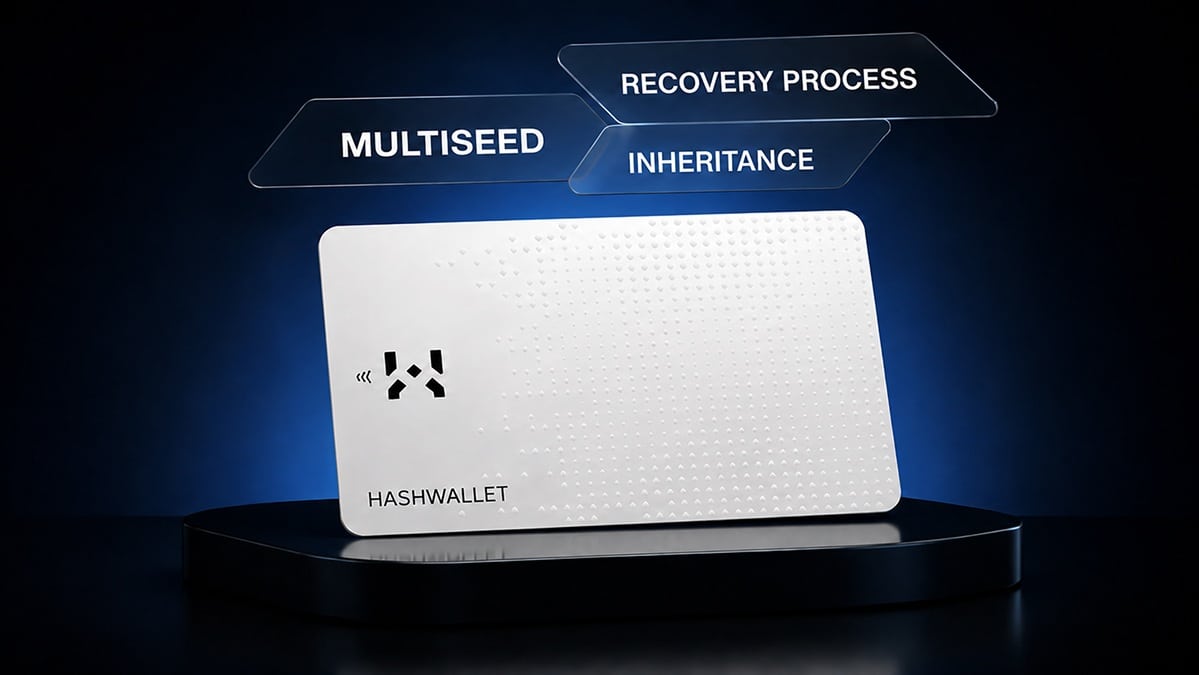
The card-shaped hardware wallet developed by Spanish cybersecurity company eSignus is reaching more markets, with a security model built around the two situations that push people back toward custodial services: losing access to their own keys, and having those keys stolen.
Hashwallet is expanding its international presence, following growing interest in self-custody among users who want to hold their own keys but worry about carrying that responsibility alone. Some drift back to custodial services to transfer that responsibility to a company, trusting that if theft or a security failure occurs, the company itself or its insurance will bear the consequences. Hashwallet is built so that choice isn’t necessary: you keep full control, with a recovery path and theft protection layered on top.
Keys that stay inside the chip
Hashwallet generates, stores, and uses private keys inside a secure chip with EAL6+ certification. The keys don’t leave the chip, and signing happens inside it too. The firmware has no command to reveal or export a key, and it isn’t updatable, so a future update can’t introduce an extraction path. New networks and features arrive through the mobile app, without touching the firmware that protects the keys.

Transactions are approved by holding the card against an NFC phone until the operation finishes. The card needs no battery or cables. It currently supports buying, sending, receiving, staking and swapping across more than 11 000 assets on multiple networks, including the Qubic ecosystem.
Recovering access without leaving self-custody
Hashwallet’s main advantage is recovery that doesn’t hand your custody to anyone.
How recovery works
If a card is lost or damaged, or the seed phrase is missing, the user can request a backup card from the app after authenticating through the security mechanisms linked to their account. When the card is initialized, the seeds are restored inside the card’s chip.
Multiple seed support for privacy
Hashwallet is a multiseed cold wallet. A public blockchain lets anyone who links one of your addresses to you trace the balance and history behind it. Keeping everything under a single seed means that one exposed address can reveal everything. With several independent seeds on the same card, you can separate funds by purpose, such as long-term savings, everyday spending or trading, so your whole financial life isn’t tied to a single address.
Prepared for inheritance
The same recovery architecture lets an owner prepare a digital inheritance. They can request an uninitialized backup card and leave it ready for their heir, without sharing private keys or granting access to the funds while alive. The email address goes in the will, and the phone line is left as part of the inheritance, so the heir can access the app and recover the funds when the time comes.
Key security and operational features
- Card format and security: A card-shaped cold wallet that keeps private keys isolated within an EAL6+ certified chip.
- Broad compatibility and functionality: Supports more than 11,000 digital assets, including the Qubic ecosystem, and enables users to buy, send, receive, stake and swap assets, as well as connect to decentralized applications (dApps) via WalletConnect.
- Recovery in case of loss or damage: If the card is lost or damaged, the user can request a backup card and, after completing two-factor authentication, the seeds are regenerated directly within the new card’s chip.
- Privacy and private key protection: The device does not include commands that allow private keys to be exported. In addition, eSignus does not have the technical capability to access users’ funds or complete the recovery process independently, as the elements required for recovery are distributed.
The technology behind Hashwallet
eSignus is a Spanish cybersecurity company specialized in self-custody and hardware-based protection for digital assets. It has received several cybersecurity awards for its innovation in the field. Through its Hardware Wallet as a Service (HWaaS) solution, it also enables other organizations to create custom self-custody solutions based on its technology and under their own brand.
Disclaimer: This publication is sponsored. Coinspeaker does not endorse or assume responsibility for the content, accuracy, quality, advertising, products, or other materials on this web page. Readers are advised to conduct their own research before engaging with any company mentioned. Please note that the featured information is not intended as, and shall not be understood or construed as legal, tax, investment, financial, or other advice. Nothing contained on this web page constitutes a solicitation, recommendation, endorsement, or offer by Coinspeaker or any third party service provider to buy or sell any cryptoassets or other financial instruments. Crypto assets are a high-risk investment. You should consider whether you understand the possibility of losing money due to leverage. None of the material should be considered as investment advice. Coinspeaker shall not be held liable, directly or indirectly, for any damages or losses arising from the use or reliance on any content, goods, or services featured on this web page.
Related Articles