Press Release
After Raising $500K in Presale, Quantum-Safe Wallet ‘BMIC’ Aims to Solve Crypto’s Biggest Problem
This content is provided by a sponsor

Crypto has seen better days. Sentiment is bearish, and many presales are struggling to produce results. But one project is slowly bucking the trend.
BMIC ($BMIC), a quantum-safe wallet platform still in its presale phase, has already raised nearly $500,000 from early backers. In a bearish market, that kind of momentum is worth looking into.
The reason for the interest? The project is tackling a threat a lot of crypto users haven’t even heard of yet, but one that experts say could wipe out billions in value within a decade.
The Flaw in Every Wallet You’ve Used
Here’s something most crypto holders don’t realize.
Every time you send tokens from a standard wallet, your public key gets written to the blockchain. It’s just how technology works. And for now, that’s not a problem. There’s no computer on earth that can turn that public key into your private key.
Machines with enough stable qubits could run algorithms designed to crack the cryptography protecting those keys. The real danger isn’t that someone will steal your funds the moment quantum computers arrive. It’s that they’re collecting data right now, waiting for the technology to catch up so they can unlock it later.
Security researchers call this “harvest now, decrypt later.” And it means any wallet that has ever made a transaction is sitting on a time bomb.

BMIC took a hard look at this problem and decided the only real solution was to build something that doesn’t leak keys in the first place. Instead of trying to patch existing systems, the team built a new architecture using smart accounts that never expose the public key on-chain. Transactions go through private routing layers, and the cryptography itself is designed to resist quantum attacks.
The project calls this method “signature-hiding.” It’s about removing the thing that gets cracked entirely.
What Makes BMIC Different
A lot of projects talk about being “quantum-resistant.” Usually that means they’ve swapped one algorithm for another and called it a day.
BMIC took a different path.
The platform is built around hybrid cryptographic models that combine classical and post-quantum signatures. If NIST approves new standards down the road, the system can update automatically. Users don’t need to migrate funds or download new software. The wallet just stays secure in the background.
There’s also an AI layer handling things behind the scenes. Machine learning models scan for unusual activity, looking for threats before they cause real damage. The same AI helps manage the heavier computational load that comes with post-quantum algorithms, keeping transaction times reasonable.
On the roadmap, BMIC has plans that go far beyond wallets. The team is building toward something called the Quantum Meta-Cloud; a decentralized network where users can access quantum computing power without going through big tech gatekeepers. Token holders will be able to burn BMIC for compute credits to run workloads.
For banks and businesses, there’s Quantum Security-as-a-Service. Companies can plug into BMIC’s infrastructure to add quantum-safe custody and key management without rebuilding their entire backend. That opens the door for institutional adoption well before quantum computers actually arrive.
The staking system is built the same way; no exposed keys, which means long-term stakers aren’t creating attack surfaces that could be exploited years from now. And the payment card layer uses the same authentication, so spending crypto doesn’t mean leaking your key.
Check out our guide on how to buy $BMIC token during the presale phase.
$BMIC’s Crypto Presale Momentum and Tokenomics
The numbers behind the $BMIC’s presale explain why early backers are interested.
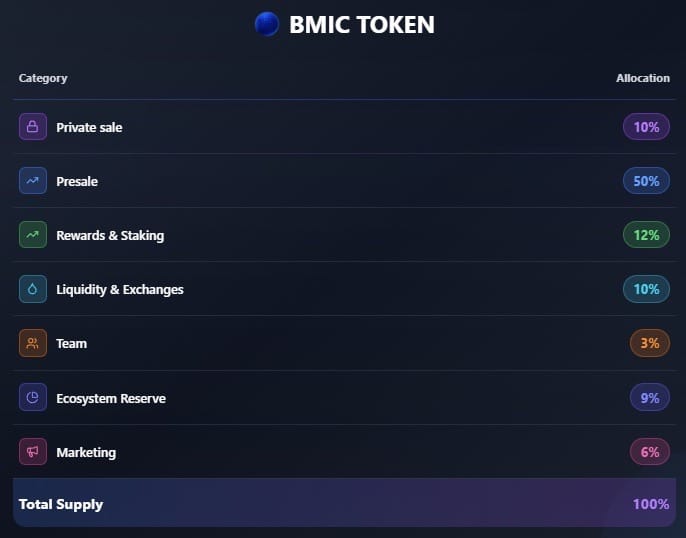
BMIC has a total token supply of 1.5 billion, with 50% allocated to the presale. That’s 750 million tokens available for early buyers. Another 12% goes to rewards and staking, 10% to liquidity and exchanges, and 9% to an ecosystem reserve. The team holds only 3%, with marketing at 6% and private sale investors at 10%.
The pricing follows a tiered model with up to 50 phases. The first buyers got in at $0.048485 per token, with gradual increases up to $0.058182 in later phases. The public launch price is set above the final presale tier, creating the typical early-bird advantage.
So far, the market response has been strong despite broader conditions. Getting to the nearly $500,000 mark in a bear market signals genuine interest.
The project also includes a deflationary mechanism. A fixed percentage of company revenue funds token buybacks and burns, reducing supply over time. That gives the token real utility beyond investment; demand is tied to wallet features, enterprise APIs, and future compute access.
Why $BMIC Matters For Crypto’s Future
Some might argue that worrying about quantum computers today is like worrying about alien invasions. But the “harvest now, decrypt later” threat is real and already happening. Bad actors are scanning blockchains, collecting data, and waiting. For anyone holding assets long-term, that’s a genuine risk.
BMIC positions itself as the answer. By hiding public keys, using quantum-resistant algorithms, and building for the future from day one, it offers protection that legacy wallets simply cannot match.
The presale is still open, and the wallet alpha is scheduled for mid-2026. For now, the project is one of the few in crypto actually preparing for the next technological revolution.
Meet the future of quantum-secure Web3 with BMIC:
Presale: https://bmic.ai/
Social: https://x.com/BMIC_ai
Telegram: https://t.me/+6d1dX_uwKKdhZDFk
Disclaimer: This publication is sponsored. Coinspeaker does not endorse or assume responsibility for the content, accuracy, quality, advertising, products, or other materials on this web page. Readers are advised to conduct their own research before engaging with any company mentioned. Please note that the featured information is not intended as, and shall not be understood or construed as legal, tax, investment, financial, or other advice. Nothing contained on this web page constitutes a solicitation, recommendation, endorsement, or offer by Coinspeaker or any third party service provider to buy or sell any cryptoassets or other financial instruments. Crypto assets are a high-risk investment. You should consider whether you understand the possibility of losing money due to leverage. None of the material should be considered as investment advice. Coinspeaker shall not be held liable, directly or indirectly, for any damages or losses arising from the use or reliance on any content, goods, or services featured on this web page.
Related Articles