Blockchain security has always been built on mathematical assumptions. For more than a decade, elliptic curve cryptography has protected billions in digital assets across Bitcoin, Ethereum, and thousands of other networks. That protection depends on one core premise: classical computers cannot efficiently break these cryptographic schemes. Quantum computing challenges that premise. Related article: Audiera’s BEAT […]


Blockchain security has always been built on mathematical assumptions. For more than a decade, elliptic curve cryptography has protected billions in digital assets across Bitcoin, Ethereum, and thousands of other networks. That protection depends on one core premise: classical computers cannot efficiently break these cryptographic schemes.
Quantum computing challenges that premise.
Large-scale quantum machines capable of breaking today’s wallet encryption are not operational yet, but research is advancing steadily. Governments and tech giants are investing heavily in quantum hardware, and cryptographers are already transitioning toward post-quantum standards.
In that kind of situation, a new category of blockchain infrastructure is emerging: quantum-aware finance. One Ethereum-based project entering this sector is BMIC ($BMIC), currently conducting its crypto presale with a focus on building a wallet, staking, and payment ecosystem designed for long-term cryptographic resilience.
$BMIC Token Utility, Tokenomics, and Crypto Presale Structure
The $BMIC token is at the core of the ecosystem. With a fixed total supply of 1.5 billion tokens, the allocation is structured to support development, liquidity, ecosystem expansion, and long-term network activity.
Here’s $BMIC token allocation:
- 50% allocated to the presale
- 10% to private sale
- 12% to rewards and staking
- 10% to liquidity and exchanges
- 9% to ecosystem reserve
- 6% to marketing
- 3% to team allocation
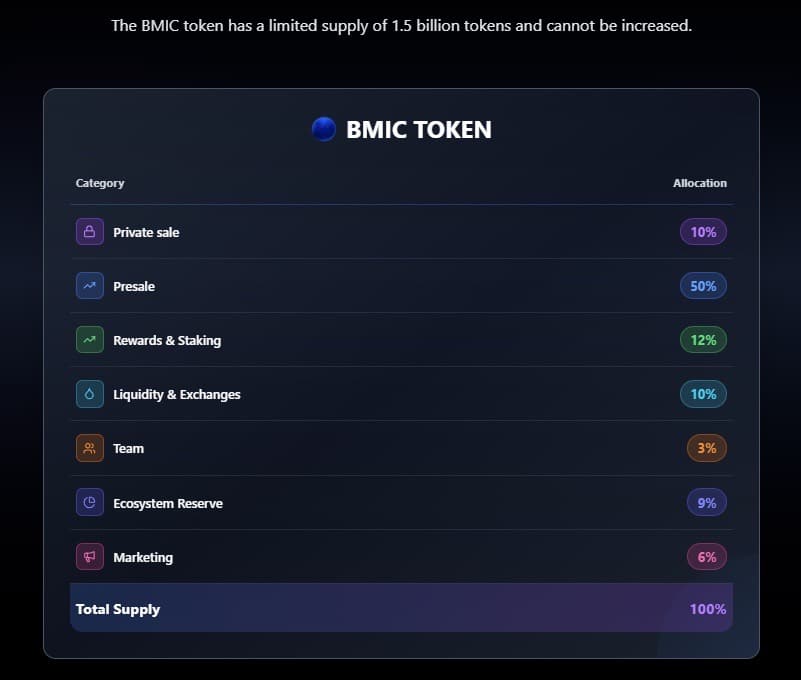

Half of the total supply being directed toward presale participation means a broad distribution strategy. The project has structured its crypto presale across multiple pricing phases, beginning at $0.048485 and gradually increasing to $0.058182. The launch price is expected to exceed the final presale tier, giving early participants preferential access within a defined range.
Utility plays a central role in the token model. $BMIC is designed to power:
- Wallet features and premium security tools
- Enterprise-facing Quantum Security-as-a-Service APIs
- Governance participation
- Staking mechanisms
- Future compute access within its planned Quantum Meta-Cloud
The roadmap also outlines burn mechanisms tied to network revenue and activity, particularly as the wallet moves from alpha to beta and eventually mainnet. This introduces a deflationary dynamic connected to ecosystem usage rather than arbitrary supply reductions.
For those analyzing the crypto presale, the value proposition lies in exposure to infrastructure. The token is framed around participation in a security-focused network that aims to serve both retail users and enterprise clients.
Building Quantum-Resistant Finance on Ethereum
What differentiates $BMIC from traditional wallets is its architecture. Most wallets today operate as externally owned accounts (EOAs), which expose public keys after transactions. In a future quantum environment, that exposure could become a weakness.
$BMIC integrates smart account abstraction inspired by ERC-4337, hybrid post-quantum cryptographic signatures, and signature-hiding mechanisms. The goal is to remove direct public-key exposure from standard transaction flows. By redesigning the account layer itself, the system reduces the attack surface that quantum machines would target.
Its roadmap outlines quantum-secure staking, a dedicated payment layer, and a crypto card system engineered with post-quantum authentication and signature-hiding routing at its core. Unlike many existing crypto cards that rely on standard key exposure during transaction signing or backend authorization flows, the $BMIC card framework is designed to minimize public-key leakage and reduce cloning or replay risks.
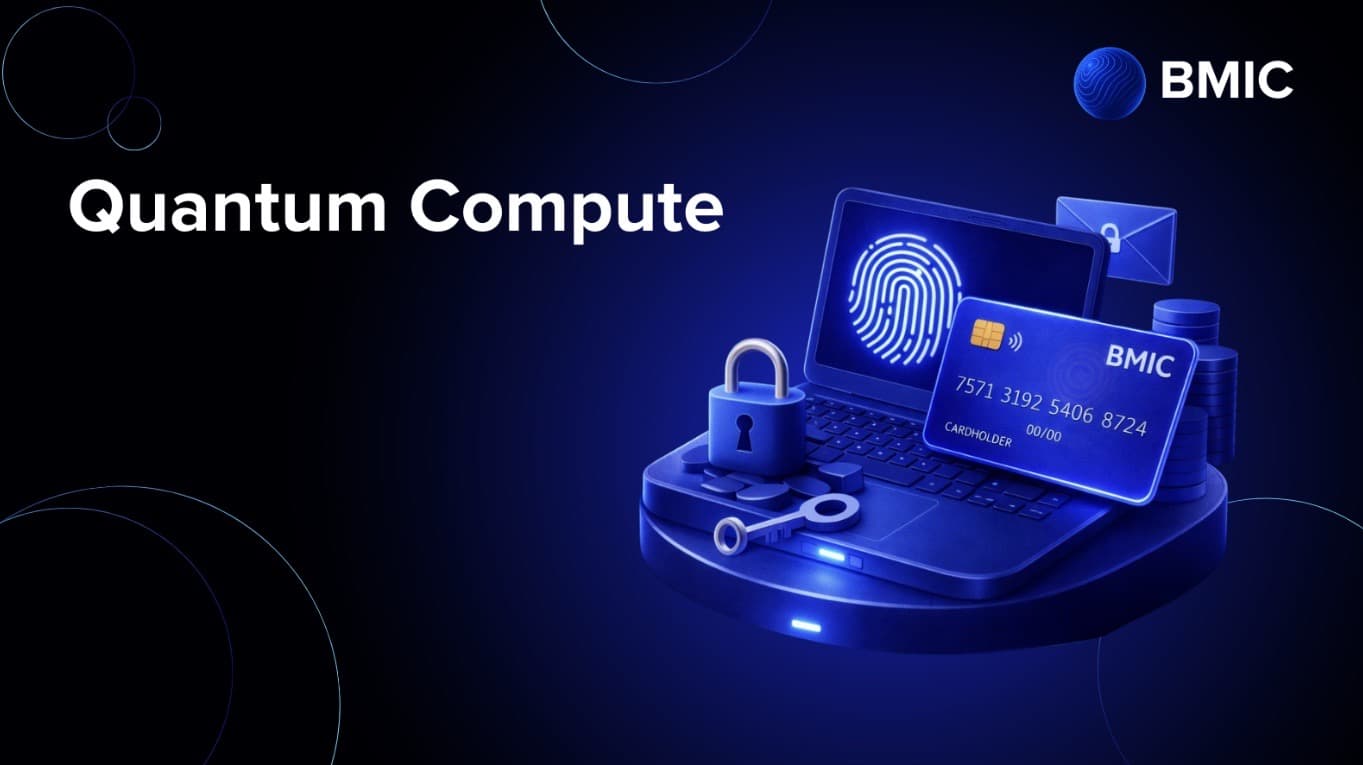

Transactions are expected to be validated through hybrid post-quantum signatures and smart account abstraction, adding an additional security layer at the authorization stage. The objective is full lifecycle protection; from holding assets in a wallet, to earning yield through staking, to spending funds globally via a quantum-aware card infrastructure that anticipates future cryptographic threats.
Artificial intelligence is also integrated into the ecosystem. AI modules are expected to monitor transaction patterns, detect irregularities, and optimize cryptographic workloads as standards evolve. As NIST finalizes post-quantum standards and new algorithms gain validation, the system is designed to update without forcing disruptive migrations.
Ethereum remains the base layer for token deployment and smart contract infrastructure. This allows $BMIC to tap into established tooling and liquidity while layering advanced cryptographic protections on top.
In effect, the project is attempting to future-proof common crypto activities: storage, staking, payments, and enterprise integration.
Security Before Crisis
Crypto has historically responded to vulnerabilities after they surface. Quantum computing presents a different scenario. If breakthroughs accelerate, reactive upgrades could become complex and costly.
$BMIC’s crypto presale arrives at a time when security conversations are gaining depth. Institutional players are examining custody models more closely. Developers are evaluating smart account upgrades. Regulators are discussing cryptographic resilience.
The presale offers structured entry into a project focused entirely on that theme. With a defined supply, phased pricing model, and roadmap extending through wallet releases, governance activation, and eventual mainnet deployment, the initiative is clearly oriented toward long-term infrastructure development.
Participation in any crypto presale carries risk, and market conditions remain unpredictable. However, for observers who view quantum preparedness as an emerging necessity rather than a distant theory, early-stage infrastructure projects often attract strategic attention.
Web3’s next evolution may not be about faster transactions or higher yields. It may be about ensuring that assets secured today remain secure decades from now. Projects building toward that objective are entering the conversation early, and the window for early participation in the $BMIC crypto presale remains open as development milestones unfold.
Meet the future of quantum-secure Web3 with BMIC:
Presale: https://bmic.ai/
Social: https://x.com/BMIC_ai
Telegram: https://t.me/+6d1dX_uwKKdhZDFk
next