
With more than $400,000 already raised, LiquidChain is moving through its presale phase with steady momentum.


The crypto presale market is crowded again. Dozens of new tokens are launching with ambitious roadmaps, big promises, and familiar narratives. Most of them will struggle to stay relevant once market conditions change. A small number, however, stand out early because they address real infrastructure gaps. LiquidChain ($LIQUID) is one of those projects.
With more than $400,000 already raised, LiquidChain is moving through its presale phase with steady momentum. The appeal is not driven by hype cycles or celebrity endorsements, but by a clear focus on one of crypto’s most persistent problems: fragmented execution across chains.
That focus is why LiquidChain is being positioned as a serious contender for the best crypto presale of 2026.
How LiquidChain Sets a New Standard for Cross-Chain Execution
In essence, LiquidChain is built to coordinate activity across Bitcoin, Ethereum, and Solana without forcing users or developers to treat those networks as isolated environments. Instead of launching another Layer-1 that competes for attention and liquidity, LiquidChain operates above existing chains as a Layer-3 execution network.


The design philosophy is simple: execution should adapt to where liquidity already exists. LiquidChain enables applications to reference external chain states directly within a unified execution environment. That means Bitcoin-based value, Ethereum smart contracts, and Solana accounts can all be coordinated through one system, without relying on fragile bridges or wrapped assets.
This removes several layers of friction. Developers no longer need to deploy and maintain separate versions of the same application across multiple chains. Users no longer need to move assets manually just to access opportunities elsewhere. Execution becomes faster, liquidity becomes deeper, and security assumptions are reduced.
In 2026, this kind of coordination is becoming the benchmark rather than the exception. As multi-chain usage becomes normal, infrastructure that simplifies cross-chain execution is no longer optional. LiquidChain is built with that reality in mind, which is why it is increasingly viewed as a standard-setter rather than just another experimental protocol.
Crypto Presale Momentum, Staking, and the Case for Early Participation
LiquidChain’s presale structure shows its long-term orientation. The $LIQUID token plays an active role in the network, supporting execution, governance, and staking. Participation is not limited to speculation; it is tied directly to how the protocol operates and scales.
Staking is a key part of that design. By staking $LIQUID, participants help secure the network and align incentives around sustained usage rather than short-term trading. More than 25 million $LIQUID tokens are already staked; a clear signal that early participants are committing capital rather than waiting on the sidelines.
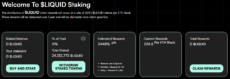

Current staking rewards remain high, but they are not fixed. As more tokens are staked, APYs gradually decline. This mechanism rewards early conviction and naturally encourages long-term alignment. It also reduces circulating supply during the network’s early stages, a dynamic that has historically supported stronger price behavior when adoption picks up.
The presale price itself adds another layer of urgency. $LIQUID is currently available at $0.131, a level that reflects early-stage risk rather than mature infrastructure adoption. As presale phases progress, pricing adjusts upward, meaning the current window is defined by time, not sentiment.
Why $LIQUID Stands Out Right Now?
Not every presale deserves attention, and not every infrastructure project executes on its vision. What separates LiquidChain is clarity. The problem it targets is well-defined. The architecture is designed around existing demand rather than hypothetical usage. The token has a functional role within the network, reinforced by staking and execution incentives.
In a market that increasingly rewards utility over noise, LiquidChain’s positioning is hard to ignore. Cross-chain execution is not a niche feature; it is a requirement for the next phase of crypto adoption. Protocols that simplify this layer tend to become foundational, not optional.
That is why LiquidChain is being treated differently from other crypto. It is not trying to predict the next narrative. It is responding to how crypto already works and building infrastructure to support it at scale.
With the presale still live at $0.131, over $400,000 raised, and staking participation climbing, $LIQUID offers early exposure to a protocol designed for where the market is heading next. Among current presales, few projects combine execution-focused design, measurable traction, and a clear role in the multi-chain future as effectively as LiquidChain.
Join the LiquidChain community on X.